

BLOG

Education vs the Postcode Lottery
We’re not talking about learning to win cash prizes from the postcode lottery you see advertised on TV. This is about the education of future generations.
Daniel Griffin gives us the low-down on how the education system can combat inequality arising from the ‘postcode lottery’.
We’re not talking about learning to win cash prizes from the postcode lottery you see advertised on TV. This is about the education of future generations.
So, what is the postcode lottery? Well, as with the real lottery, the outcome is determined by chance. We have no influence over critical factors - like our postcode - that can dictate our success. It is proven that those of us born in certain situations and locations are disadvantaged from the get-go.
The difference in attainment between wealthy and poor students has been reported as up to 40% and the figure is growing (i). However, poor students that make it to further education perform well. Studies have shown that those entering university from low-performing schools tend to have lower qualifications on entry, but there is no significant difference in their performance at university when compared to wealthier students (ii).
This begs the question, where do the problems lie and why are young people from disadvantaged backgrounds less likely to succeed overall?
The problem in education and beyond
Currently, our schools are full of incredible individuals trying their best to improve the prospects of young people. However, they also have their own families and problems to deal with. We cannot let this issue rest on their shoulders alone.
It is no secret that state schools are overcrowded, underfunded and struggling to keep young people engaged. In some areas, student to staff ratios are upwards of 30:1 (iii). This leads to disengagement, apathy and lesson disruption. Teachers are spread so thin that they cannot keep up with the learning requirements for each individual student.
Those of us born into affluent families, and/or wealthy areas are immediately advantaged. There is a greater chance of these families being high-earners, able to afford private education and tutoring for their children. This leaves a sizeable gap between those growing up in impoverished areas and those in more affluent areas.
Many families on the breadline are fragmented and unable to afford basic needs for their children. This bleeds into the lives and expectations that young people have for themselves, shatters their confidence and self-respect. In turn, these factors form an environment where it is difficult for many young people to achieve their academic and career goals.
Confidence
Young people are versatile, capable of developing their skills faster than adults. Many have faced and overcome the built-in economic and societal barriers that would hold them back. So why not all?
The capacity of children to learn and grow is incredible. However, self-doubt is often heavily instilled in their minds. Be it from comparing themselves to their peers or experiencing condescending attitudes from adults. The resultant lack of confidence can have drastic negative effects on their motivation and work ethic.
Young people need an environment that allows them to understand their strengths and weaknesses. They need adults in their lives that can bolster their confidence. It may only take a single person to make that difference.
Role models
The importance of role models for children is often described as a key factor that helps to form their goals and aspirations. Disrupted families are common in low-income households, which can frequently impact the availability of support and guidance for young people. This is by no means the fault of struggling single parents, but a symptom of the systemic problems that deny some children the grounding they need to succeed. In the absence of regular contact with a reliable role model, young people may become apathetic and unmotivated.
We can change this. As Brexit and the general election looms, there is an opportunity to renew focus on government intervention. Direct funding to schools could take the form of personal development schemes for students. They may also help to fund organisations like CoachBright to improve social mobility projects nationwide. This gives students a chance, for potentially the first time in their life, to benefit from one-to-one coaching and tutoring. This improves confidence, helping to cement both short and long-term goals. Overall, role models can be personal champions for young people, which is an essential component for their education and development.
Establishing goals
Think back to when you were 14, 16 and 18 years old. What were your career goals? Now think about where you are now in your life. How much have your aspirations changed throughout your development? The answer is usually a lot. The skill to set appropriate goals and attain them is a crucial factor that decides where we end up in our adult lives.
But young people from disadvantaged backgrounds often experience a day-to-day struggle that prevents them from honing this ability. Many grow up too fast, whether due to caring responsibilities for siblings or disabled parents, or working part-time to supplement their household income. This skews their perspective away from thinking about their destination in life and towards the present challenges. Career services vary dramatically from school to school, meaning that the education system currently fails to provide many young people with adequate guidance.
However, the continued acceptance and implementation of programmes that focus on goal setting for pupils promises to kick-start a new trend in education. If we can provide more tailored support for individuals through mentorship and coaching, we can foster environments where young people can think and talk about their future. This is a vital step in the right direction that offers us a chance to level the playing field and open doors for those disadvantaged by their background.
So, let’s keep this social mobility train going and lay the foundations for tracks that will lead young people to happier, more fulfilled lives.
Author: Daniel Griffin, West Walsall Programme Coach.


Gambols and Tip-Tops: Do Regional Accents Affect the Way We Are Perceived?
“What I did not realise was that accents, the words you use and the colloquialisms you adopt can go a long way in creating a “class ceiling”; with the most elite companies favouring people without regional accents and dialects.”
I, like many of the people who lived with friends whilst at university, spent a lot of time arguing over the correct way to say “grass” “bath” and “castle”. The ‘right’ name for a bread roll (a cob? a balm? a bap? a teacake?) was an ongoing debate and everyone spent the first week of freshers trying to mimic each other’s regional twangs.
What I did not realise was that accents, the words you use and the colloquialisms you adopt can go a long way in creating a “class ceiling”; with the most elite companies favouring people without regional accents and dialects. In fact, a 2015 study found that people who stayed completely silent were viewed as more intelligent than those with a Birmingham accent. Another study even linked a person’s accent to their likelihood of committing crime.
But it is not just about the accent you use to make your point, it is the way in which you do that.
Sociologist and linguist Basil Bernstein wrote extensively about the difference between the ways that working class and middle class students use language. He called these “Elaborate (middle-class) and Restricted (working-class) Code”. In short, elaborate code pulls from an extensive repertoire of vocabulary and is able to adapt to a variety of social situations allowing the user to manipulate their linguistic resources to make their point. Restricted code uses a much less formal sentence structure and an often narrower vocabulary (especially synonyms).
So, why does this matter?
School is taught in elaborate code. Exam mark schemes require certain words and sentence structures. Whether or not your writing adheres to the ‘academic’ style at university (and even pre-uni with personal statements/applications) is dependent almost entirely on your ability to manipulate vocabulary and syntax. To receive qualifications, score highly in speaking exams and become more ‘academic’, you need to be able to master elaborate code, which for some seems unnatural and antagonistic to their communication styles at home.
Now, I pose this question: does it really matter how someone explains photosynthesis as long as they have a solid understanding? Does the way you speak about a subject denote that you know more or less about it? Is an essay written in perfect academic form more of a worthwhile read than one that is not? If I use colloquialisms, am I worse at my job?
Radical change would see schools and universities recognise the merits of all forms and expressions of knowledge. Maybe a conversation about Macbeth is just as valid as an essay?
In any case, as potential future employers and interviewees alike, what we can do for now is our best to recognise privileges and mitigate bias.
And if you cannot? well, yu’m thick ay ya.
—
Blog Post by Jennifer Love, Midlands Programme Officer
Battle of the Bottom: An Editorial on UK versus US Social Mobility
“…yes, things are going to be quite challenging and you are fighting against the national averages but we are going to try to give you ever tool, tip and trick we know to help you achieve your goals despite all of that.”
The United Kingdom and the United States, two of the most powerful socio-political countries in the world, have been fighting for the bottom spot among 1st world social mobility statistics for decades[i]. At CoachBright, our mission is to draw attention to and eventually eliminate this disparity. At times, it may seem like a never-ending battle, but I thought that sharing my story would allow for a more hopeful view of what we try to do for disadvantaged pupils in the UK.
I was born and raised in the United States (Ohio by way of Colorado by way of California, etc.) in a lower middle-class family. My mother was a single parent of four children by the time I was thirteen; and due to her two jobs, I was an unpaid babysitter, tutor and maid until I left home. However, I was always completely sure of my goal to get a degree and become an academic, but this was a goal I did not realise until fifteen years later in the United Kingdom.
America is founded on an ethos of Manifest Destiny, can-do attitude and meritocracy. I (like most Americans) grew up hearing that working hard was how you achieved your dreams. This is reinforced even today with feel good articles commonly found on Facebook[ii]: articles and stories that reinforce the idea that even in the worst circumstances, you can achieve your dreams as long as you work hard. Unfortunately, children are actually less likely to go into further education or make more money than their parents[iii].
This is what happened to me. I worked hard, got the grades, got a few scholarships, got a lot of loans (at 9.6% interest) and worked nights my first semester at OSU to cover the rest of my tuition fees. By the following year I had taken a sabbatical because I could not afford it. A few year later, I moved to the UK with my husband, waited patiently for three years to become a permanent resident, did an Access course, and ten years after I left high school I got my BA from The University of Exeter with only a measly £25k debt to the government (a year's tuition back home).
The point of my story is in no way to say that the UK is the land of dreams where “if you work hard you can achieve it”. They are mired by the same issues as the US; however, when it comes to higher education, there are many more opportunities for those people to work hard and achieve, and CoachBright exists to allow access to those opportunities.
We are showing children that, yes, things are going to be quite challenging and you are fighting against the national averages but we are going to try to give you ever tool, tip and trick we know to help you achieve your goals despite all of that. We hope that this is the first step in affecting change at a systemic level, a way for all children to have the same chances.
—
Blog Post by Arielle Woods, Programme Officer in the South West
—
[i] https://www.pewglobal.org/2017/04/24/middle-class-fortunes-in-western-europe/
[ii] https://www.theguardian.com/us-news/2018/mar/28/which-country-has-the-worst-class-system-the-uk-or-us
How Could We Reduce the Attainment Gap in the UK?
“If all teachers were to take on the belief that no child should be disregarded, the gap in attainment between disadvantaged children and their advantaged peers would be significantly reduced”.
I have been an academic coach at West Walsall E-ACT Academy working with GCSE students between October and December, and more recently year 13 students between February and March. I hope to commence my training to be a geography teacher in the coming September, and as part of the application process I have been asked to give a presentation on why the following statement holds true in 21st century Britain:
At the end of Primary school, pupils for disadvantaged backgrounds are 9.5 months behind their non-disadvantaged peers. By the end of secondary school, the gap in attainment more than doubles to a gap of 19.2 months [1].
Currently government policies and the media increasingly target the quality of schools for the attainment gap in students, often focusing on the achievement of those at GCSE and A-level age. However, these reports often fail to acknowledge that only 14% of variability in attainment is directly due to the quality of a child’s education with the vast majority resulting from social disadvantage [2].
Like most contemporary reports, this post defines a disadvantaged child as one who is known to have been able to access free school meals within the last 6 years [1]. The financial situation of students often propagates into further difficulties within a child’s life including; engagement in school, confidence and access to opportunities which their advantaged peers may receive.
Although the ratio of advantaged to disadvantaged children in the British education system is relatively small, it is imperative for the reasons behind the attainment gap to be understood so that future policies can be influenced by these. Currently only ¼ of disadvantaged adolescents receive 5 good GCSEs at the end of year 11 [2]. Along with this, paid jobs often require a higher level of education (for example a degree), and so many of these students will follow their parents’ footsteps in minimum wage employment or receiving benefits. This extrapolates the percentage of the population who are disadvantaged.
Over the past 6 months, I have an academic coach at the social mobility enterprise CoachBright, an organisation which works with disadvantaged 10-30-year olds in Birmingham, London, Wiltshire and Exeter. I have personally observed an increase in attainment with the students that I have worked with, with the programme seeing an improvement 4.4 times larger than their peers who did not participate, likely as a result of 82.2% of students implementing a higher standard to their school work [2]. It is fundamental that young people are given the space and support to grow through programmes like CoachBright, as children thrive in conditions where the sole focus is on their development.
It has been shown that behavioural and emotional problems experienced in children between 6 and 8 significantly diminishes the probability of a child achieving high grades in school and enrolling at university [4]. Whilst it is in early childhood where interventions (similar to that of CoachBright’s primary school programme) to mitigate disadvantages are most successful [4], I believe that no child should be denied the opportunity to experience activities which appear to be standard for their advantaged peers.
Outside of school activities can help to improve self-belief [2], therefore I believe that all children should be able to access free sports groups through school, and perhaps more importantly, participate in charity work. This enables students of all backgrounds to gain an appreciation for their wider community and develop confidence within a group using creative outlets, which can be applied to their academic career. This is fundamental in improving self-confidence, as often students have a poor attitude towards learning not because they see education as pointless but because they are not nurtured in the classroom.
Furthermore, Kiernan and Mensah (2011) have shown that disadvantaged families who experience positive parenting were more likely to be successful in school [4]. In order to extend this into the child’s school experience, it is important for teachers to discuss with a student who was misbehaving why their behaviour was inappropriate rather than just disciplining them through the school’s protocol. This is because studies have shown that those who feel that they have been let down by authority figures need to have these feelings addressed before they are able to re-engage with the curriculum [2]. Not only this but education should be a shared enterprise between, parents, students and their teachers. As many parents in poverty are unable to provide the resources to help their child’s education [2], it is important for a conversation to be opened between schools and parents to allow for the provision of revision materials of pens, pencils and other necessary revision materials to be worked towards.
In conclusion, if all teachers were to take on the belief that no child should be disregarded, the gap in attainment between disadvantaged children and their advantaged peers would be significantly reduced.
—
[1] The Education Endowment Foundation (2018:2)
[2] https://www.jrf.org.uk/report/experiences-poverty-and-educational-disadvantage
[3] http://www.coachbright.org/school
[4] https://link.springer.com/article/10.1007/s13524-017-0554-6
Blog Post by Shannon Addy, Coach on our West Walsall Programme in Birmingham
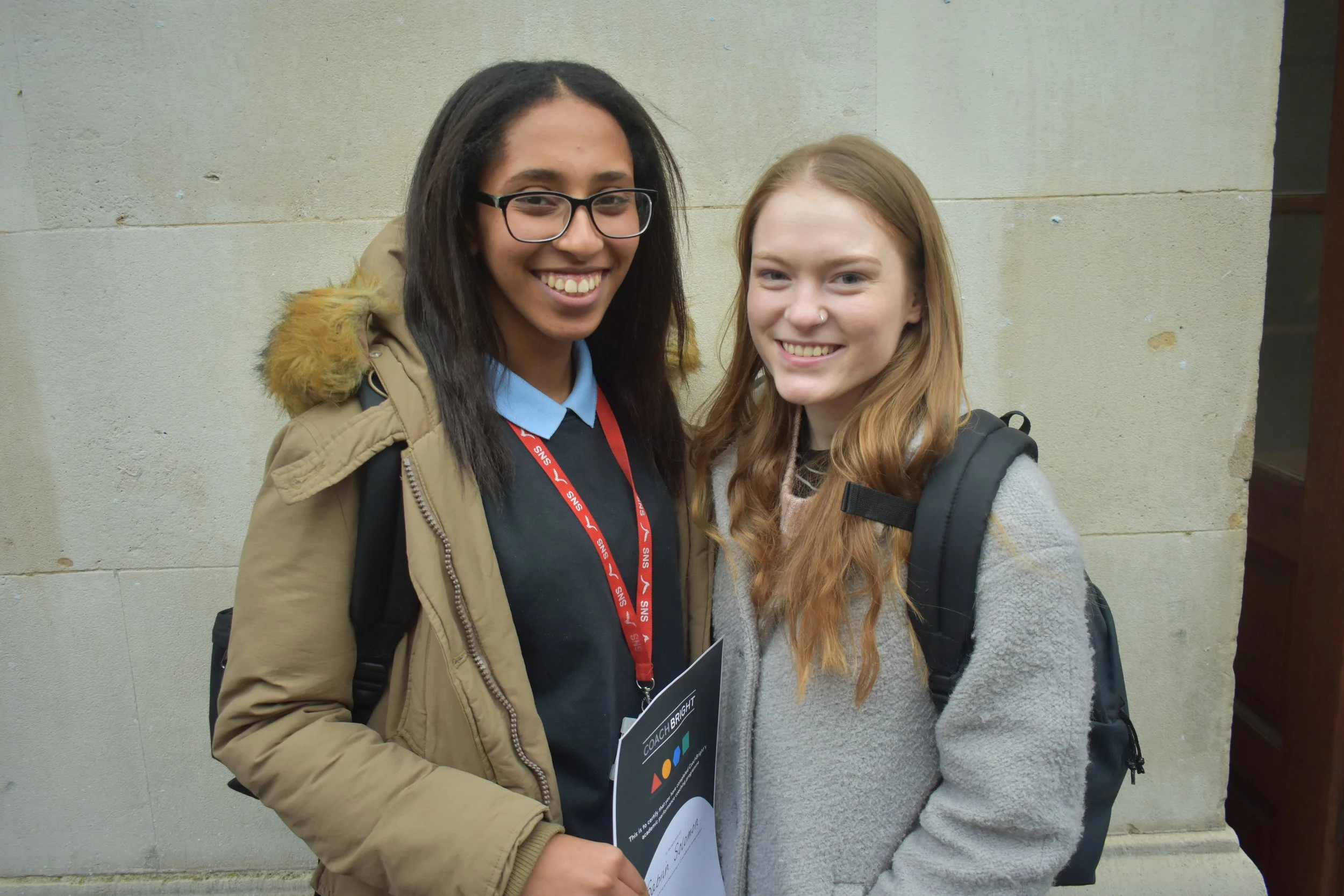

The Social Mobility Issue
“Programmes such as CoachBright are essential for providing younger students with an insight into the possibility of university”
Have a read of one of our Coaches’ insightful comments into the issue of Social Mobility in the UK!
When I was at school, university was an expectation rather than a possibility. I was surrounded by students who all had the same anticipated future ahead of them. For a long time, I thought this was just the reality for people my age. However, the older I’ve grown, the more I realised that the rhetoric surrounding university and the opportunities I was given were a privilege. Britain’s Social Mobility Index proves how slow the country is with regards to offering equal opportunities to children. This generates a new question: ‘had I grown up in a different area, would I have had the same opportunities I’ve been given?’ The answer is probably not.
The UK is one of the least socially mobile countries in the world[1] which would explain why private school pupils comprise up to 40% of the intake of top universities such as Oxford and Cambridge, despite the fact that only 7% of the UK’s children attend private education.[2] Programmes such as CoachBright are essential for not only providing younger students with insight into the possibility of university, but also for reminding those studying in higher education of the impact their geographic location may have had on their current prospects. CoachBright is a vital social programme that paves the way for other initiatives to ensure that we, as a country, acknowledge that there is a social mobility crisis and that changes need to be made in order to make a very uneven playing field more equal.
Blog Post by Elizabeth Winter - Birmingham Coach
[1] https://www.theguardian.com/news/datablog/2012/may/22/social-mobility-data-charts
[2] https://www.theguardian.com/commentisfree/2018/sep/20/university-factory-failed-tony-blair-social-mobility-jobs
Why the Millennial ‘issue’, isn’t an issue
"At CoachBright, we believe that organisations often misunderstand the needs of their young workforce." Why do we struggle to work with Millennials? How can we learn to see their strengths and use them constructively in the workforce to build stronger relationships?
Robin's recent article describes the common stereotypes associated with Millennials and how to overcome them.
I am one of 13.8 million people in the UK who are called millennials and make up 35% of the workforce.
The term “millennials” broadly describes those born between 1980-1995. Generation Y is another term for this group, and the internet was born when we were children so we are history’s first ‘Digital Natives’.
Employers often see us as “ego-massaging” graduates who are not ready for the “real world of work”. The Confederation of British Industry (CBI) states that a third of companies are unsatisfied with our work because we do not show resilience, self-management and social skills. This phenomenon has been labelled by author Simon Sinek as “the millennial problem”, characterised by our need for constant praise and organisations often losing people they want to keep. In fact, around 43% of millennials plan to leave their jobs within the next two years.
However, organisations can take various opportunities to inspire the next generation of leaders to achieve their true best in the world of work. We are more purpose-driven, collaborative and creative than any other generation.
Firstly, consider purpose: 75% of millennials would take a pay cut to work for a company with more social responsibility compared to 55% of people from previous generations. Having lived through the financial crisis of 2007-08 and starting our careers in debt through student finance, we require more from businesses than just profit making. We want to work in environments that prioritise society and individual wellbeing. For example, by ensuring that CSR departments are no longer bolt-ons, but are rather well integrated within the culture of an organisation. Workplaces need to embrace the mindset of a triple bottom line: people, planet and profit, where economic success is only a third of a company’s aims with the other two thirds being the wellbeing of its stakeholders and the impact on society as a whole.
Secondly, consider collaboration and creativity. Young professionals often prefer to work in smaller, more flexible teams with shared goals and ambitions instead of competing against their peers. This is seen in part through the rise of co-working spaces in London, starting in 2012. Mainly aimed at micro-businesses and freelancers, this new trend has spread across larger organisations as well, from Innocent Drinks to Camden Council, where people no longer use fixed seating arrangements, but rather decide where to sit every day. Neil Usher, workplace director at Sky states that co-working spaces “excel in collaboration with a warm, residential and engaging aesthetic.”
Additionally, growing up in an age of constant connectivity through Facebook messaging and Whatsapp groups, millennials are natural collaborators, used to instantaneous feedback loops. New productivity tools such as Slack or Google Docs were created to stimulate quicker response times within teams. Have you noticed how younger team members embrace new technologies quicker to get the job done faster and better? For employers, this collaborative, energetic and solution-focused attitude provides great advantages.
The building blocks are there.
Then, one might ask, how come I still struggle with my young team?
At CoachBright, we believe that organisations often misunderstand the needs of their young workforce. A common feature among graduate programmes seems to be a relentless focus on learning the processes of the organisation and the knowledge required to thrive in that industry (e.g. tax exams, commercial law or information softwares). There seems to be less training in influencing others and being and behaving in a team. At CoachBright, we know you can only bring your best self to work if you understand yourself. Only through self reflection and feedback can you truly see what your strengths and areas for development are. Gaining this awareness can be just as tricky. It requires patience, training and a framework. We believe that coaching, an approach that helps learners explore and come up with the answers by themselves through exploration and challenge, is key.
That is why we have partnered with the Academy of Executive Coaching (AoEC) to launch the first of its kind Young Professionals Coaching Skills Certificate. It is aimed at people aged between 18-30 and is delivered by faculty who are themselves millennials. The course focuses on training young professionals in the coaching skills of listening, reflecting and questioning, so that they can better understand themselves in the world of work and take major steps to become their best selves in their profession.
In conclusion, we know that there is an ambitious group of future leaders out there who want to become the best they can be in their professional and personal lives. With their driven, collaborative and creative personalities, all they need is a spark from us to help them take off.
-
Article by Robin Chu, CEO of CoachBright, AoEC partner.
AoEC offers coaching, triple-accredited coach training, and consulting to individuals and organisations worldwide looking to embrace positive change through empowering people. For more information please visit the Young Professionals Coaching Skills Certificate webpage.
Why Coaching Needs to Happen Earlier on in Your Career
Most people who have heard of Coaching tend to associate it with Senior level Executives developing their own sense of self in the workplace. However, CoachBright’s Head of Programme Mary explains why Coaching is in fact needed much earlier on in life. Read her most recent article!
Coaching can be a transformational experience to help individuals become more aware of who they are, where they want to go, and how to get there. However, it has traditionally been a gift shared only with senior executives in the latter part of their career.
Fortunately, organisations who understand the benefits of coaching are beginning to offer junior members of staff this opportunity as well, and it’s promising to see coaching cultures emerge in an increasing number of workplaces. As well as helping young professionals feel more fulfilled at work, coaching contributes towards the overall success of a business, as these individuals can play a bigger part in their team and not be held back by all too common self-limiting beliefs.
For an individual to be effective in a team they must be self-aware. Understanding and owning up to your strengths, being aware of your weaknesses and having a sense of your values help when it comes to bringing your best self to a team. Self-awareness is increasingly seen as critical for ‘Millennials’ success. Consistent, honest feedback at work is one way of achieving this. Another one is coaching, which gives clients the opportunity to reflect in a safe space and gain insights into their behaviour and what drives them forward. John Whitmore notes that “the first key element of coaching is awareness, which is the product of focused attention, concentration, and clarity”.
An understanding of personal values is one element of self-awareness gained in coaching. Once someone is aware of what is fundamentally important to them in life, their decisions will be guided by this and they will make choices early on in their career that make sense for them. It is also useful for a young professional to see whether their values are aligned with those of the organisation that they are part of. Being able to select roles in companies with shared values means that an individual is more likely to find themselves in an environment where they are a ‘good fit’. In fact, personal-organisational value conflict has been found to be linked to lower job satisfaction, so the sooner an individual knows what their values are, the less time they will spend in an unsatisfying job within a company that is not right for them.
Another outcome for those fortunate enough to experience coaching early on in their career, is a significant increase in confidence. Being able to make sense of current situations in a safe, non-judgemental space, and having the time to work through possible solutions to problems can be empowering for the young professional and result in increased confidence when they re-enter the workplace. A coach can also challenge their self-limiting beliefs, such as the perception that their manager does not trust them, or that colleagues think they are too inexperienced, for example.
Being more self-confident and feeling like they work in an organisation whose values align with their own contributes towards a higher motivation at work, but the coaching process can also significantly increase their day to day personal motivation. Setting short-term goals with their coach specifically related to their jobs, employees would focus on solutions to challenges and try out these solutions to make small steps towards the goal between coaching sessions. This process empowers the individual and makes them feel more motivated, leaving them with a ‘can do’ attitude in the workplace.
-
Article by Mary McPherson, Head of Programmes at CoachBright, AoEC partner.
AoEC offers coaching, triple-accredited coach training, and consulting to individuals and organisations worldwide looking to embrace positive change through empowering people. For more information please visit the Young Professionals Coaching Skills Certificate webpage.




An Unlikely Observation About Resilient People
Chloe Garland is one of our Associate Coaches on the Young Professionals Programme with AoEC. In this article, she talks about resilience and why it is important! Read on…
Posted by our Associate Young Professional Coach Chloe Garland
Recently I have found that most of my coaching conversations have led back to the same topic: resilience. Resilience is the ability to take valuable and committed action despite difficult internal or external conditions. I don’t profess to be a resilience expert or to be made of steel myself, but I wanted to share one common theme that seems to separate resilient and non-resilient people. Simply put, resilient individuals don’t try to control negative thoughts.
They seem to be able to accept two things:
Negative thoughts are normal by-products of a difficult situation
There is nothing we can do to change or stop negative thoughts, and doing so is a waste of time and energy
Here are two internal chains of events from a resilient and not-so resilient person to demonstrate the point:
The Not-So Resilient Person
When a not-so resilient person is triggered by a difficult event, a flood of negative thoughts arise. At this point, the individual will try their very best to regain control of the thoughts by trying to rationalise, change, or delete them. Here begins a negative cycle commonly known as a ‘spin’. Whilst all this energy is spent trying to prevent being washed away by a tide of internal chatter, there can only be two outcomes: the first is to react unhelpfully or unproductively, and the second is to not act at all.
The Resilient Person
When a resilient person is triggered by a difficult event, a flood of negative thoughts arise. The resilient person knows (either consciously or subconsciously) that trying to control thoughts does not work, and can accept them as a normal by-product of a difficult event. By accepting this, they bypass the spin and gain the mental space to be able to decide how to act helpfully and productively to the situation. In short, giving up control of thoughts allows us to gain control over our behaviour.
The important thing to note is that both individuals feel the negative thoughts. The difference is the degree to which they try to control them. Perhaps some people are born with a larger ‘resilience muscle’ than others, but just like a muscle, resilience can be strengthened with practice and time.

How To Strengthen The Resilience Muscle
Notice when the negative thoughts arise and the wave of sensations they bring
WAIT before acting. Do anything that will help you wait a moment, sing a little song in your head, take 5 breaths or ask yourself: ‘is what I am about to do helpful?’. There is a reason why parents say to children to count to 10 before reacting to a situation. By doing this, they can let their initial reaction pass through so that they can be in a better frame of mind to choose how they want to react.
STOP TRYING TO CONTROL THE THOUGHTS. Remember it is pointless to spend your energy on trying to do this. It does not work and is like poking an angry bear.
Ask yourself ‘what would be the best possible thing I could do in this situation?’ and do that.
Of course, this is much easier said than done, but unfortunately there is no silver bullet for being resilient. It is gritty and uncomfortable, especially when your resilience muscle is weak. Similarly to how the first few months in the gym are the hardest, it takes determination and repeated practice for our muscles to start to grow. And although we may never stop feeling the strain entirely, we may begin to feel comfortable with the discomfort.
If you have any tips about dealing with discomfort, or about the topic of resilience in general, I would love to hear your thoughts.
chloe@quarter-life.co.uk
Originally published on LinkedIn: https://www.linkedin.com/pulse/unlikely-observation-resilient-people-chloe-garland/
Wrapping up #EducationalJusticeUK campaign and Annual Report 2016/17
In the last of our #EducationalJusticeUK blogs, CoachBright founder Robin looks at why the focus of our campaign is so important.

By Robin Chu, CEO and Founder of CoachBright
“While the government seems unable to devote the necessary energy and focus to the social mobility agenda, I have been heartened that others in civil society – from local councils to major employers – are actively embracing it.” These are words lifted directly from Alan Milburn’s resignation letter from being Chairman of the Social Mobility Commission 2 weeks ago. Most of the press coverage has focused on the first part around poor political leadership and the lack of energy outside of Brexit from our nation’s politicians. We must instead look to those who are actively supporting the social mobility movement.
Our campaign around #EducationalJusticeUK concludes this week and we made a conscious choice to focus on what works and what is being done to improve social mobility for our most disadvantaged pupils. We do acknowledge, however, that more needs to be done and quicker. At our current rate, it will take 15 years to narrow the ability gap between rich and poor at the age of five, and 80 years to close the gap in higher education participation rates.
While the progress of social mobility may be slow, it is heartwarming to see so many individuals and organisations driving significant change. Take our live tweetchat around the issue. Headteachers, teachers and education organisations from across Manchester, Essex, Exeter and London all engaged:


There is a swell of energy and excitement driven from the ground up - passionate committed teachers launching #TeachMeet’s #WomenEd, #BameEd events across the country. Clearly, as educators, there are key examples of us taking the fight to social injustice.

This very fight is at the top of CoachBright's agenda - our work aims to help close the educational gap between the rich and poor. This seems like a great moment to release our Annual Report 2016/17 (last academic year) to the public! In it, we detail the impact, successes and mistakes we have made. Here are some quick highlights below:
Class of 2017: 70% of CoachBright pupils have gone to the UK's top third most selective universities.
Grade impact: CoachBright pupils improve their subject grade 2.2 times more than their non-coached peer.
CoachBright has supported 343 pupils over last year.
Please do have a read here and we would love to hear your thoughts.
If you are interested in what we do as a school leader, corporate or to volunteer please do reach out and get in touch at robin@coachbright.org
Levelling the Playing Field
It's Week 4 of our #educationaljusticeUK campaign and Matt Jones, Principal of ARK Globe Academy in London, has written about the problems with access to university and what can be done to help.
By Matt Jones, Principal of ARK Globe Academy
Recent media reports have made clear that there is not a level playing field when it comes to social mobility and access to university. Only 7% of the population has had the choice to attend an independent school, yet this small percentage is wildly over-represented in our top universities and in their access to the best and highest-paying professions.
This situation has motivated 108 MPs to write to our most prestigious universities calling for significant changes to end this "social apartheid". More worryingly, the Social Mobility Commission’s report, Time for Change, indicates that despite billions of pounds of taxpayers' money being spent on policies to improve access to top universities and the professions, very little has changed in 20 years.
In fact, if you are a state-educated child today, you are much less likely to work in medicine or become a journalist compared to 30 years ago.
During the five years that I have been Principal at Ark Globe, the gap between independent school educated children and state school educated children accessing the most selective universities has actually widened. The government provides universities with approximately £800m each year to improve access to higher education.
Clearly, this strategy is not making a difference.
Ark Globe, in south-east London, is in an area with high levels of economic deprivation – it’s an area where very few parents are able to afford an independent school education, meaning their children face an enormous statistical disadvantage when it comes to accessing the best universities – before they’ve even cracked a book.
Yet despite this, 100% of Ark Globe’s sixth form students received a university offer last year. Of those, 62% went to a ‘top third’ university and 48% to a Russell Group university. We are particularly proud of Zareen, the first Ark Globe student to be admitted to Oxbridge. She is now studying Human, Social & Political Studies at The University of Cambridge and such is her achievement that the BBC’s World at One programme is tracking her progress throughout her first year at university.
The percentage of Ark Globe Academy students accessing top universities is approximately three times the state school national average (23%) and is similar to that of independent or fee-paying schools (65%).
So, how did we achieve such impressive outcomes for our young people?
There is no simple answer, but importantly, we have worked hard to create a culture of aspiration and high expectations, something I have spoken about in many different forums. This is reflected in Ark Globe’s mission statement: ‘Preparing our students for university and to be leaders in their community’.
The fact is that being ambitious and earning strong exam results are not enough. Young people also need access to opportunities and the cultural capital required for university access and success. At Ark Globe we also work to provide some of the same opportunities for our students that pupils from more financially advantaged backgrounds get to enjoy. These include university visits, networking days and mentoring sessions.
We have a team of extremely knowledgeable and dedicated teachers and support staff, assisted by the Ark Pathways & Enrichment team. Their job is to reach out to organisations and institutions that can help to prepare our children in accessing the best universities or apprenticeships – anything to help even the playing field.
Our enrichment programme features a wide range of external speakers and cultural experiences that guarantee our students know what to expect and how to conduct themselves in our elite higher education institutions. These activities help to build their confidence, deepen their understanding of university life and ensure that nothing – or at least very little – is a surprise to them when they eventually attend university.
Finally, our students are encouraged to be independent and take matters into their own hands. Our sixth form students often make connections with professions and organisations in employment sectors that interest them through their very own Ark Globe networking event, through social media or via personal contacts.
The Ark Globe community; parents, students, staff, local residents and corporate partners are all committed to working together with the aim of ensuring our children have the same opportunities as any another child in the country, regardless of their postcode, ethnicity or wealth. Sadly, this is not the case everywhere.
While I am obviously proud of what we have accomplished so far at Ark Globe, I don’t think our school should be a statistical anomaly. I often speak to many other successful leaders in education doing amazing work in the toughest of circumstances. Like me, they are concerned that their students are not getting a ‘fair crack of the whip’. I wonder what we could achieve if government were to give some of that £800m directly to schools?
£184 million (24%) could provide funding for every state secondary school in England to employ a careers advisor and university access coordinator.
£80 million (10%) would let us send all secondary school students every year on a visit to a university.
£40 million (5%) would buy access to expert mentoring for all 16-18 year olds in sixth forms.
I do not suggest that these investments alone would be the key to unlocking the potential of all children, but these are a few examples of how schools could use the money to improve access to our most selective universities. We need the success of students at Ark Globe to be a standard, not an exception. Our current national policy on social mobility is failing, and without major reforms the divisions and inequalities in our society will widen and grow.
With adequate funding for the non-academic support needed to improve access to university and top professions, I believe schools are in the best place to enhance social mobility; after all, they know their children, families and community. My hope is that by properly resourcing and empowering schools and their local communities, the success of young people like Zareen will no longer be a newsworthy story, but rather just another everyday example of a student fulfilling his or her potential.
1. Time for Change, Ch.4, P.79
2. DfE: Widening Participation in Higher Education
Matt Jones started his career as a professional footballer before going into education. A graduate of Ambition School Leadership’s 'Future Leaders' programme, Matt has been Principal of Ark Globe Academy since May 2012
"A,B,C, it's easy as 1,2,3?"
Navigating the Trials, Tribulations and Triumphs of the Numerical Grading System
For the second guest blog of our #EducationalJusticeUK campaign, a Head of Year 9 and English teacher at an inner-London secondary school tells us about getting to grips with the new GCSE grading system!
Navigating the Trials, Tribulations and Triumphs of the Numerical Grading System

Anyone who was teaching English in a secondary school prior to the summer of 2015 may well remember the period with quite a large sense of nostalgia. A time when an A* was an A*, a C grade was recognised as the benchmark everyone wanted to achieve, controlled assessment protocols were definitely being “followed” and George and Lennie’s dream was still somewhat alive.
In 2015 all of this changed; English departments had been trying to prepare for the GCSE overhaul since Gove announced the sweeping changes to the system. The changes included, but were not limited to: the scrapping of controlled assessments, four exams at the end of the two year course, changes to the texts studied, closed text exams and of course the changes to the grading system. Gone were the letters which had served countless generations so well. Why did the good, old fashioned letters of my exam certificates have to go? Were they no longer fit for purpose? And what was to replace them? Numbers 1 to 9.
The multitudinous questions that were thrown up by this change just kept coming. Questions came from fellow department members, students, confused parents and even SLT; and I knew these questions were not just limited to my school. Friends in other schools were equally as confused, this felt oddly reassuring - no one really seemed sure of what to expect. Ofqual released a table of the new grade system with comparisons to the old grade system. The changes stated that 4, 5 and 6 would be variations of the old B and C grades and that 7 and 8 would be variants of an A or an A*. They even added a grade 9, the equivalent of an “A**”. Yet again, more questions. Would the school be judged against our 4 or 5 grades? Which grades would Sixth Forms want? Which grades would be acceptable to take an English A-level? How could you compare students who had received a B grade just the year before under the old system with students who received a 5 or 6 under the new system?
Despite the largely unanswered questions we began the task of trying to plan and teach the new course, I had a class of students who had Target Minimum Grades of between 3 and 5. Every class has a unique set of challenges, but having a class were the majority of students are on the borderline of a “good pass” (and that achieving this “good pass” is not secure), is something I have always found to be pretty challenging. You want to stretch the class so that they can achieve their personal best but I have never wanted to do this to the point where students feel unmanageable pressure and in some cases even fear; fear of failing, fear of letting themselves or others down. At the best of times these worries and fears can be difficult to alleviate but when you as a teacher are not completely secure what constitutes which grade on a piece of work this becomes nigh on impossible.
Over the course of two years we kept ploughing our way through the GCSE; chipping tirelessly (and, I’ll admit it, often tiredly) at the sometimes seemingly impenetrable language of Victorian non-fiction, attempting to explain the context of ‘A Christmas Carol’ or exploring the subtlety of metaphor in Wordsworth’s ‘The Prelude’. As with any school entering data is part of the everyday workings of my institution and so I, and the rest of the department, endeavoured to enter what we believed to be the most accurate data we could. When you have no past papers available, limited model responses and assessment objectives that are open to interpretation this task becomes even more complex. Yet we kept plugging away, entering data and feeding back to our students and parents at every step; guiding students with what they needed to do to maintain or achieve the next grade up. Along the way we kept giving the information to students that we had, in turn, been given that a 5 was a pass and that was the target we needed to be aiming for. Then in March 2017, less than eight weeks before the GCSE exams were due to start, Justine Greening wrote a letter to the Education Select Committee Chair. The letter, an attempt to provide “certainty” around the different grades, what the grades meant and what would be considered a pass. Again all of this coming at the end of March. Weeks before students across the country were due to start exams. The impact? More questions, more uncertainty. The group most impacted by this letter? The students. The people who were sitting this new, uncertain GCSE.
During the next eight weeks year 11 concluded in the same ways as it always has - leaving speeches, shirt signing, class photos and a prom. We offered after school revision classes and sessions before the start of the exams as we had always done. As each of the four English exams were sat there was a feeling of entering the unknown. Would the extracts be the ones we had predicted? Would the students follow the advice we had liberally handed out? As with any exam season, once the students walk into the exam hall the die is cast; all you can do is hope for the best and wait till August.
There is much to enjoy and relish about results day; some teenagers who rip open their results envelopes with the gusto of a small child at Christmas, to the more nervous students who chose to open their results in a quieter place, often away from the stares of eager teachers, parents or peers. Then there are those whose results are not what they hoped for – despite best efforts or in spite of personal struggles, and sometimes tragedies, that have marred their time as a teenager at school. As a department we set to the task of working out what we had achieved and as we had been doing for the past couple of years asking ourselves questions: what would we do differently now that we had a set of results? How could we ensure that any further announcements or changes that were made outside of our control did not have a negative impact on our students?
As my current year 11 approach the second set of exams and I’m now helping to guide my third group through the sometimes murky waters of the GCSE, the tempestuous seas of the new course seem to be calming but the storm does not appear to be over. At least not yet.
This blog was written by a Head of Year 9 and English teacher at an inner-London Secondary School.
We’re not talking about learning to win cash prizes from the postcode lottery you see advertised on TV. This is about the education of future generations.
Daniel Griffin gives us the low-down on how the education system can combat inequality arising from the ‘postcode lottery’.