

BLOG

Why Inspiration is Important to Learn
“Learning is not about getting everything right or checking things off a list, it is about nurturing an attitude of perseverance and resilience.”
I have always loved literature and I leapt at the chance to continue studying it at university – it seemed like the perfect place to satisfy my voracious appetite for both fiction and new ideas. When I look back at my time at school, it is difficult to pinpoint where my love of learning originated from. However, there is one overwhelming memory: I remember all of my English teachers. Crucially, I have positive memories of all my secondary school English teachers even though they were all very different in their teaching styles and personalities. Digging a little deeper, I realise that they all had one thing in common: they all inspired me to keep learning.
It seems like it should be part of a teacher’s job to keep you learning, but my teachers went the extra mile for me by recommending books that I would never have picked up otherwise and suggesting new concepts for further independent research. My teachers motivated me to keep learning beyond the boundaries of the curriculum by having patience and recognising my potential.
I realise now that learning is often a difficult and isolated journey to commit to on your own – especially without the right support structures. I have been very fortunate in my academic experiences and I want to share that good fortune with someone else. This is what CoachBright has taught me how to do. Not only have I developed the skills to show someone how to keep learning, but I now have a greater understanding of what made my teachers so inspiring.
Learning is not about getting everything right or checking things off a list, it is about nurturing an attitude of perseverance and resilience. Learning demands patience; it is the courage to ask questions and seek out answers, even if those answers lead to more questions. Making a commitment to keep learning is made easier by inspiring role models; they show us how to keep trying, how to work our problems out and how to re-evaluate our situation when things still are not going our way. CoachBright has allowed me to reflect on my own passion for learning and it provides its coaches across the country with the skills to build this foundation for someone else, so that their journey becomes easier as they grow older.
—
Blog Post by Amirah Muhammad, Coach in London





How does Culture Influence us and our Learning?
“The culture and ways of thinking that our children are exposed to will determine how they will grow and the mindset they will have as adults”.
We come in the world as a “Tabula Rasa”. John Locke described it as our mind being a “blank slate” without rules for processing data when we are born, and all these are formed solely by one’s sensory experiences.
Everything we do has been influenced by an occurrence at one point in life. We all live in a social world, a world shaped by different ideas which society has been built on. These ideas make up our culture. We tend to focus on specific areas that have more meaning and relevance to us based on our individual experiences. However, the ideas that our social groups are built on also form cultural differences. When talking about intrinsic motivation, cross cultural research suggests that Americans tend to perform better if they have had some form of previous success which motivates them to progress and keep going. Meanwhile, the Japanese are more likely to do better if they are faced with failure, as that will motivate them to work harder in the future. The cultural space we live in shapes the ways we perceive various tasks. Excellence and success are the desired outcomes, but the approach to these can be different.
I studied in Romania and now I live in the UK. I have observed many differences in the way teachers deliver information, the support provided to learners and the learner-teacher relationship. In my homeland, elder teachers raised in a communist world are less likely to promote the children’s creativity and critical thinking, and rather drag them down for what they do not know. Younger teachers attempt to change this by promoting uniqueness and implementing better methods; however, the education system seems to be “on pause” rather than forward thinking and adapting to the world’s current needs.
Wherever I go, I keep asking myself “So why is this relevant to me?”. Individuals fail to see the importance of information that lies as a foundation to our world. I believe this happens often due to lack of real life examples in correlation to our current times. Learners do not see the essential applicability, especially now as technology is rapidly developing and everyone seems to be living a faster life.
By being part of CoachBright, I have discovered that by supporting our younger peers, we help them to find meaning in their learning, find their own answers, reach their potential, and approach the path they choose to follow.
The culture and ways of thinking that our children are exposed to will determine how they will grow and the mindset they will have as adults.
Blog Post by: Carla Bodea, Coach on our Erdington Academy Programme in Birmingham
#5 in the Series "Voices of our Coaching Team"
Meet Nicholas (or Nick!), the Head Coach voice of this week’s series. He will be joining the London Team this term. In this blog post, Nick discusses the reasons why he loves university life and coaching.. read on!
Hey everyone! My name is Nick, and I'm studying Arts and Sciences (a liberal arts programme) at University College London. I am originally from Singapore, and I am currently in my second year of studies.
I adore university life! I enjoy the freedom and independence that I found in living away from my parents and my country or origin. I get to discover more about myself and others; and the agency I possess in charting my life course is incredibly liberating. In my first year, I tried out professional dance for the very first time, I tried out consulting pro-bono for non-social enterprises, and I made friends from all over the world in my hall of accommodation. UCL is very diverse and provides a highly inclusive atmosphere, bringing its students limitless opportunities to meet others from different walks of life.
I heard about CoachBright from my good friend Nicole, and I have never regretted the decision to volunteer. CoachBright is unlike any other social enterprise that I have worked with in the past - it is brimming with vibrant energy, and this can be attributed to the boundless optimism that the entire management team bring to their work. Even as a student Coach, I was a part of a collaborative atmosphere that was inclusive and motivational. It definitely encouraged me to bring my best self at every session.
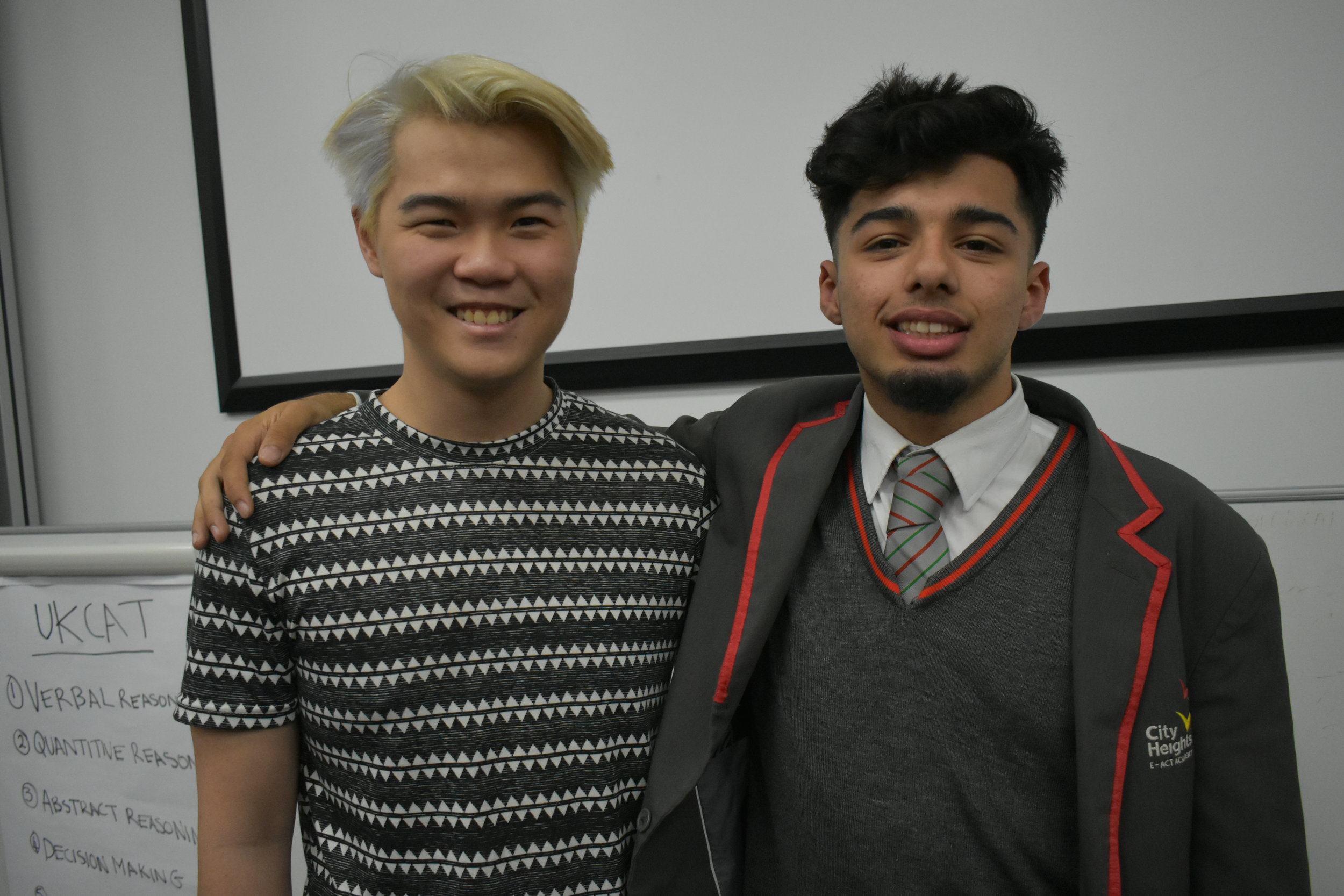
The photo above was taken at my coachee Tariq’s graduation from the CoachBright programme. Becoming a part of CoachBright will allow you to establish a close relationship with your coachee, inspiring them to work hard in their studies to join you in university, while enabling you to build your skills and confidence in coaching.
Blog post by: Nicholas Oh
#4 in the Series "Voices of our Coaching Team"
Meet Nadya, one of our future Head Coaches in Birmingham this term! In this blog post, Nadya reflects on her volunteering experiences to encourage others to volunteer. Read on!
What is it like to be a CoachBright Volunteer ?
Firstly, why should you volunteer?
Not only does volunteering give you that sense of achievement and satisfaction that you’re doing something for someone else, but it also shows you the impact of what you do on those that you are helping.
Why getting involved with CoachBright?
I decided to volunteer with CoachBright after seeing an advert on Facebook. The organisation intrigued me, as I want to go into teaching; so coaching GCSE students and primary school children has given me a constructive and positive experience, as well as deepened my knowledge. I would definitely recommend students to volunteer with CoachBright, as it enhances your communication and leadership skills and introduces you to various aspects of management. It also helps you to gain confidence in your own abilities.
My experience volunteering with students in both primary and secondary education has enabled me to transfer all my skills to the work that I have done with CoachBright. The students that I have coached through CoachBright have come away with the satisfaction of knowing that they can conquer any maths puzzle and even be of help to their peers. When I volunteered in the primary school, I realised that giving certain students that extra level of attention and time enabled them to increase their self-esteem and self-confidence when faced with difficult maths questions. When I coached a secondary pre-GCSE student in English, this not only increased my knowledge of the subject but it also allowed me to converse with the student on a more mature level.
Why become a Head Coach?
Now that I have been given the role of Head Coach, I can now pass on my knowledge and experience to other coaches who are new to CoachBright. Being a Head Coach will give me more responsibility and therefore help me to enhance my leadership, management and organisational skills. I am really looking forward to taking on this new role at CoachBright.
Blog Post by: Nadya Cohen
#3 in the Series "Voices of our Coaching Team"
Meet Rania, one of our future Head Coaches - In this blog post, she describes how coaching benefitted both her and her coachee, and why more people should volunteer! We are very happy to have her as a part of our new Head Coach Team!
Hello,
Can I just start by saying how excited I am to start this year as a Head Coach at CoachBright? I will be starting my second year at King’s College London, studying International Relations. I’m half-Turkish, half-Indian, though I was raised in Ankara, Turkey, for my whole life. Coming from a country where students are in vicious competition with each other over the best universities, and where the richest student with the most opportunities ‘wins’, I’ve got a lot to say about educational inequality.
I volunteered with CoachBright in early 2018, because it gave me the opportunity to take action. Witnessing the students’ eagerness to learn, and how much they appreciated the help from their coaches added just that much more to my first year in London. On top of that, when I received a message from my coachee, decorated with smiley emojis and an “I couldn’t have done it without you”, I knew that volunteering and changing someone’s life was the best way to make use of the time at hand.
I know that having a coach is helpful because I too, benefitted from it. The fifteen minutes of coaching that I experienced during our initial training took me from feeling like an isolated, lonely mess with no time management skills, to someone that trusted themselves and understood the importance of tackling tasks one at a time. The routine that CoachBright brought into my life was much needed and well timed, and I will always be thankful for signing as a volunteer.
To anyone that wants to volunteer for CoachBright- from the bottom of my heart, I encourage you to take a step towards helping yourself and helping another student. You will see just how big of an impact you can have on the lives of those surrounding you. Don’t just observe. Take Action.
Blog post by Rania Mohiuddin
#2 in the Series "Voices of our Coaching Team"
Meet Daisy, one of our future Head Coaches - In this blog post, she describes why tackling educational inequality is important to her. We are looking forward to having her on our Head Coach Team this term!
Carrying on studying … carrying on at CoachBright
Hello everyone!
I have just graduated from the University of Exeter, where I was awarded a 2.1 with honours. I studied English Literature, and I am a few weeks away from beginning my Masters in Literature and Culture at the University of Birmingham. I am very keen to start a new journey in Birmingham, however what makes it more exciting is that I am also beginning my new role as a Head Coach at CoachBright.
I volunteered with CoachBright as a Coach for two years in Exeter, which was one of the most rewarding things I did during my undergraduate studies. Therefore, I am thrilled that I am expanding my role here as well as developing my academic career. I am particularly interested in the “Culture” aspect of my Literature and Culture MA, as it combines my two interests in education and literature. Within any functional society, education is fundamental, as it provides the means to make withstanding contribution to culture. After completing my Masters, I intend to follow this interest further and potentially teach abroad. Educational inequality is something that I feel very passionately about. I understand that in this country, guaranteed education is something that can easily be taken for granted. However, it would be wrong and naive to assume that the UK does not harbour educational disparity. This is why volunteering for charities like CoachBright is crucial.
Unfortunately, university is becoming increasingly difficult to access. The fees are expensive, and the repayment schemes are becoming increasingly unappealing, particularly for students who come from low income backgrounds. Pupils born in disadvantaged families often attend state schools, which often lack sufficient funding. This means that facilities and educational opportunities are minimal and little time is spent encouraging and explaining how or why students should be going to university. Many of them do not even see university as an option, let alone a viable one. Consequently, pupils often lack self-esteem and they do not believe that they are “good enough” for higher education.
CoachBright works with these students on an invaluable one to one basis in order to raise their confidence in their personal and academic abilities. As university students, the coaches are knowledgeable of the reality of being at university, and how rewarding or daunting it can be. We can offer advice and support to encourage pupils to see their academic potential by focusing on subjects they find difficult. Coaching can be a challenge for both the coach and the coachee, yet the sense of achievement they both achieve is incredibly rewarding. On a micro scale, you are having an impact on both the students’ and your own confidence; while on a macro scale, you are contributing to changing the unequal social landscape of educational opportunity.
I would recommend all university students to volunteer for CoachBright, regardless of what they study or what they do in their free. It is a social enterprise that is rapidly expanding and making a difference in students’ lives in both the short-term and long-term.
Blog post by Daisy Saunders
#1 in the Series "Voices of our Coaching Team"
Meet Erika - one of our former coaches on the Stoke Newington Programme. In this blog post, she writes about her experience as a coach for CoachBright, and why it was all worth it!
January signalled the beginning of a new year, and with that my first time volunteering at CoachBright. Needless to say, I was nervous about the whole thing. Filling out the application form, doubts were swirling in my mind as to whether or not I was good enough for the role. Would there be an interview? If so, would I have an intimidating interviewer looking down disdainfully at my lack of experience and credentials? However, these thoughts abruptly came to a halt. For as soon as I had submitted my application form, I instantly got an e-mail inviting me to partake in a coach assessment day. I went feeling even more nervous about having to be assessed, as well as the fact that I would know no one there.
For the second time, CoachBright surprised me. To my relief, there were no critiquing middle-aged adults ready to whisk me into a room for an interview. Instead, I was greeted by people who were both friendly and practically my age! I could finally breathe with the knowledge that I had met friendly faces.
Two painless training sessions went by, and I was quickly assigned to a seven-week programme in Stoke Newington. I was introduced to a sweet girl who had dreams of dabbling in criminal psychology, but struggling in aspects of AS Psychology. For our hourly sessions therefore, I helped my coachee to slowly overcome the difficulties of the subject. Likewise, I overcame the initial hurdle of preparing for these sessions and organising my time between CoachBright and my own priorities at university. Not to mention to need for refreshing information that I had completely forgotten after finishing my A-Levels a few years ago! However, the entire experience was enriching, and I would honestly volunteer again.
As someone who struggles with self-doubt, my English GCSE teacher took extra time out of his day to help me improve my grades and my confidence. If anything, I wanted to give that same help and become that same figure for my coachee.
Blog Post by: Erika Hayashi
From Rural to Urban: My Student Journey
For the final week of our #educationaljusticeUK campaign, Exeter University student and Coach Wil Jones has written about his personal experiences journeying from an agricultural college to a large university campus and the issue of engagement.
By Wil Jones, University of Exeter Student and Coach
When I was in secondary school, the nearest university was half an hour’s drive from home: a small, specialist agricultural college in the heart of the countryside. It felt a world away from my conception of university at the time – that they were these vague, distant establishments dotted around the country, places people would flock to, optionally extending their education in order to experience the bright city lights.
That muddied idea of what university was and could be – and the disbelief that anyone would want to choose to go there – came from a place of misunderstanding: a disengaged 15 year-old’s misconception proving to be just as big a barrier as any physical distance from a university campus.
My school became a Business and Enterprise College shortly before I started there, and over five years there was an evident transformation; as well as an impressive new sports hall, a purpose-built business centre and reception area was built.
For all the evident benefit and appeal of these developments the effect on the student body wasn’t always easily discernible. The near-mandatory requirement to study some form of business-related subject at GCSE was alienating for the significant portion of 14 year-olds who weren’t enthused by the prospect of profit margins, and other areas within the school – not least the creative elements I engaged with the most – felt like little more than an afterthought when it came to funding.
During my final two years at school, there were subjects I loved, with truly inspirational and supportive teachers, yet sadly there were also subjects where this was not the case, and – exacerbated by negative experiences outside school – it became an unhappy time. Despite this, I left school with generally good grades, albeit having lost interest in the sciences that had at one point been utterly captivating, resulting in my choosing not to continue with them as I moved towards the sixth form.
Once in the sixth form, at a post-secondary college, the disengagement I had felt in school ossified in this new environment. As some of my friends went through the process of applying to university, and others prepared for the world of work, I struggled to do either. Although I worked hard to pass my A Levels whilst also holding down a part-time job, good grades felt more than a little inconsequential once I left college unsure at how to apply them to a work setting.
In the end, with a good portion of my friends having left the town, and with others settling into vocational work, it was only due to the incredible persistence of a friend that I applied to university at all. Having someone passionate and supportive is utterly integral to motivation and achievement and something I have found so common amongst the CoachBright coaches I have had the pleasure to meet and coach alongside.
I am now coming towards the end of my time at Exeter University, where I am studying English. Doing a part-time degree, although an uncommon route to take, has enabled me to slowly acclimatise to university life whilst also earning through a part-time job. That process of adaptation has been a lengthy and at times difficult one, in no small part due to my previous disengagement; when I arrived, I had never stepped foot on a university campus before, let alone attended an open day. In short, I was largely unprepared, despite achieving quite well academically.
CoachBright has undoubtedly been one of the highlights during my time in Exeter. Having been given a truly inspiring and eye-opening framework on coaching, the opportunity to help my coachee in a focused manner with their academic work – whilst also encouraging more general aspirations – has been rewarding personally, but also hopefully provides that crucial support to a student when they need it most.
In my experience, engagement goes beyond attendance or whether a student does well in their exams; whilst good grades are key to achievement and I would encourage every student to aspire to do their very best, a more holistic approach to education can undoubtedly aid that aspiration, in turn improving engagement, achievement, and social mobility as a whole. The manner in which the CoachBright coaches have inspired their coachees has been heartening to see; I wouldn’t hesitate to recommend any students interested in becoming a coach to do so.
Coming to Exeter I was surprised that it didn’t feel a world away from where I grew up despite my previous preconceptions; so much so that I often describe it as larger, similar version of home ‘but-with-a-university’. It’s a fairly crucial ‘but’, however, as during my time here the 15 year-old’s expectations have been utterly shattered. Whilst the hills may feel familiar there are so many aspects that have been challenging and rewarding in equal measure; rather than this being a reason to dissuade people from applying to university, I believe it reinforces the need for young people to have someone supporting them to not be put off by the daunting elements that come with pushing yourself as there is so much opportunity at university, and access to those opportunities should not be limited by social disadvantage.
The manner in which CoachBright demystifies university with a supportive platform helps young people to make informed choices on their futures, and I believe that can be just as important as good grades.
Wil Jones is a third-year English student at University of Exeter and has been a Coach with CoachBright since September 2017.
Coachee Catch-up with Jake !
In the second of our Coachee Catch-up series, we caught up with Jake. He shares with us his university experience and some advice for prospective university students. Give the interview a read!
"Being at uni has given me a bigger sense of family " - Jake
By Aliya Nabil with Jake Nichol
Hey Jake! Thank you so much for agreeing to do this for us! Can you tell us a little bit about yourself before we go into the other questions?
Hi everyone, my name is Jake Nichol! I finally finished A-Levels last year and left the London Nautical School after 7 years, which started off terribly but ended amazingly. I'm currently at the University of Bedfordshire studying Sports Journalism as if you haven't guessed already, I will be a sports journalist.
Tell us a bit about sports journalism as a course. How did you find out about it and why did you decide to take this course?
I always knew I wanted to be a journalist. Seeing as I am obsessed with motorsport - watching it not necessarily playing it - I decided that a sports journalism course was for me.
During our free lessons in Sixth Form we were told to be productive and so I started to look at potential courses and universities around the mid-point of Year 12. On the UCAS website, the University of Bedfordshire was the one that always kept popping out to me and when I went for the open day, it just felt right.
The lecturers, their knowledge, the location of the university and just my gut feeling told me that this was the course and university for me -that's why I ended up here.
How are you finding university life, is it comparable to school in any way?
Uni life isn't comparable to school life in any way for me personally. It doesn't matter if you miss a lecture as the notes will always be put online. I can actually get hold of who I need and I'm actually studying what I want – no irrelevant subjects on top !
Making new friends was always a problem for me, but since I've been at uni and been on a couple of nights out, I've really settled in. Also, discovering that the magic cleaning up fairy doesn't actually exist has made me a lot more conscious and aware of how to tidy my room, both at home and at uni!
What makes the university experience unique?
Obviously being away from home and having to cook, clean and do your washing makes uni something most of us have little experience of. The ‘on the fly’ nature to it as well makes uni just special in its own way.
Like in January, I went to Toys R Us and bought a £65 Nerf gun, just because I could.
You can just be you. At school, you are steered towards this or that. At uni you join what clubs you want and if it isn't for you, you can just say no, rather than having someone try and sell it to you.
If there is something you could tell your past self (pre-university) what would it be?
Chill out. I was a worrier and so uptight pre-uni, even as I was packing to leave home. After 2-3 weeks, I finally relaxed and settled in. I have had the time of my life. It really is amazing!
You were part of the Advocacy Academy and had coaching, has that influenced you in any way?
Coaching has definitely helped me to think out of the box. I was always an in-the-box thinker. Adam (my coach) discussed some fresh thinking tips with me and allowed me to see things from the other person's view. Once I had decided I was going to uni, it was good to have someone who wasn't family or a teacher give me uni advice, whom I knew would say the truth and be brutally honest.
What do you think makes a good coach, would you ever consider being one?
A good coach must want to make a difference. They must want to do it for someone else. With Adam, he listened to what the problem was, what I was thinking of doing about it, and then gave advice which was relevant to my actual situation - not one that he may have had a similar experience of doing in the past. You must be able to listen and not go off on a tangent when talking.
If I have the time, being a coach would be something I would like to do. The journey I went on with Adam from the uptight quiet guy to speaking to Year 7 and Year 8 about my mental health issues was fun. I knew that I wanted to share my story with more people, but didn't know how. Then we came up with the idea of having assemblies with them, explaining what I went through and how they could avoid it. A Year 7 student was feeling isolated and lonely, and I made it my personal mission to get him comfortable around his peers. That gave me even more satisfaction than doing the assemblies.
I'd like to help someone else have that journey of believing in themselves and doing what is right, not just for them, but for others.
If you could tell every person in the world one thing (the same thing), what would it be?
Chill out. The best thing I learnt to do was not to worry/care too much. My life has become 1000% times better.
What are your plans for the near or even distant future?
After I finish uni for the year in May, on my hit-list is to get round to doing my driving test, get a job for the summer and continue with my Motorsport stuff. I've got some exciting things ahead with it, and can't wait to do them!
Coachee Catch-up with Costa!
We caught up with one of our former coachees; Costa , who is now at university! As a self-proclaimed 'child of outreach programmes', he shares with us what such programmes provide down the road.
Costa with his flatmates and neighbours after a Secret Santa Exchange !
By Aliya Nabil with Constantino Christou
Here, we catch-up with some of our former coachees to see how they are doing at university. Our first interviewee is Costa, a former coachee and graduate from the Advocacy Academy. Read the interview session below to find out more!
Can you tell us a little about yourself?
My name is Constantino ('Costa') and I am from Croydon in South London. I used to study at Bishop Thomas Grant school in Lambeth (where I spent 7 years) and am now studying for a BSc in Politics and International Relations at the University of Exeter in Devon.
How has university life been for you so far?
So far university life has been everything I wanted it to be; I enjoy my course, the facilities are great, I love the town and I've met some great people. The sense of freedom and independence, though daunting, has been invaluable to my personal development.
If you could give a heads-up to prospective university students out there, what would your advice be?
Any prospective student should place the course above all other aspects of the university. Although things like location, accommodation and reputation are important, it is vital that you enjoy/are interested in the course you are studying, because if you don't like the course, you won't enjoy it once the freshers fun is over in second and third year. Also, now is the time to explore and do things you wouldn't otherwise do, so make the most of the opportunities that present themselves. That being said, don't feel pressured into making bad decisions!
How did you find the transition from school to university?
The transition from school to university was fairly smooth, the only real draw is not having my friendship group there to support me at the toughest part - the first month or so. In sixth form we had a lot of hands-on support right in front of us, both academically and otherwise. At university, it is up to you to seek out the support that you need. So far I have found my lecturers and tutors very helpful and hands-on in addressing my concerns, and they make time for me like my A Level teachers did - the main difference being that I had to email beforehand to agree on a time.
My first term modules were introductory and so weren't too much of a departure from my A Level course content. In second term I am expected to do more independent research which is both taxing and highly enjoyable. Again, if you enjoy the subject you are studying and are passionate about it, the transition to university will be positive.
Obviously, you were on the Advocacy Academy and had coaching, how did you find it?
The Advocacy Academy was the best experience of my life so far - it taught me what it is to be a leader and it gave me an appreciation for my community that I didn't have before. Coaching came at a really important time in my life and it gave me the guidance and support I needed, when I really needed it.
Is there any advice that still resonates within you?
What both TAA and coaching taught me was the importance of seeing the bigger picture, which resonated with me greatly. I can now approach everyday scenarios, in addition to broader political and social issues, with a more informed perspective that many others do not have.
You were part of the CoachBright Advocacy programme before as a coachee, would you ever consider being a coach ? If yes, why?
CoachBright gave me an appreciation for making one-to-one time with the people I care about, be it friends or family. I apply this whenever I am in need of support from my loved ones and in turn I can provide that for them as well. A few years down the line perhaps, I would love to become a coach. As a self-proclaimed 'child of outreach programmes', I feel like I have a lot to offer to young people who are in the position I was a few years back. Not everyone is lucky enough to have role models and I think having a coach or mentor in some form is vital to one's personal development.
Lastly, do you have any plans for the future?
I have applied to a couple of internship programmes (with Unilever and the Civil Service) and am hoping to start a new blog in the spring, so I'm definitely keeping busy. Ideally, I would like to become a civil servant working in housing policy, but marketing is also an interest of mine so I am keeping a fairly open mind about it.
“Learning is not about getting everything right or checking things off a list, it is about nurturing an attitude of perseverance and resilience.”